Greener, Smarter, Scalable: Rethinking RFID and NFC Antenna Production
As demand for RFID and NFC technologies accelerates, sustainable manufacturing methods like Dry Phase Patterning (DPP) and renewable materials are redefining how antennas are made- cutting waste, reducing costs, and enabling scalable, circular production.

09 Jun, 2026. 5 minutes read

Wireless data transmission technologies such as Radio Frequency Identification (RFID) and Near-Field Communication (NFC) have grown rapidly in recent years.The RFID market alone is expected to expand from $20.1 billion in 2024 to $47.6 billion by 2030.[1]
This significant growth is driven by increasing adoption across industries including retail, e-commerce, logistics, healthcare, and manufacturing, where these technologies enhance asset tracking, supply chain traceability, inventory management, and more.
In order to meet this growing demand, the RFID/NFC manufacturing industry has had to scale rapidly, an ongoing process that has brought with it certain challenges, in particular related to scaling the devices in a sustainable and economical way. This challenge is multifaceted: bottlenecks driven by complex production workflows and the cost of traditional RFID materials have created hurdles, while the industry has had to contend with the fact that mass-etched RFID and NFC tags are responsible for considerable waste from the production process and e-waste at the end of their lives.
Fortunately, technological developments are creating more sustainable alternatives for manufacturing RFID/NFC tags at scale. Technologies like DP Patterning’s Dry Phase Patterning for instance, have a role to play in solving both scalability and sustainability challenges that the industry faces today.
The state of RFID/NFC production
Traditionally, many RFID and NFC antennas have been manufactured using a subtractive etching process, where unwanted conductive material is removed from a metal-coated substrate to create the antenna pattern.
In a typical copper etching process, a photoresist layer is applied in the antenna pattern to a copper substrate (often on a flexible plastic film such as PET). A mask containing the antenna design is used to selectively protect the desired areas, after which the unprotected copper is dissolved using a chemical etchant. The remaining photoresist and etchant residues are then removed, leaving a patterned copper antenna on the flexible substrate.
While currently widely used, this process brings with it a number of challenges, including scaling difficulties related to the multiple steps involved in etching the antennas, and ecological challenges related both to material waste and water usage and contamination. Moreover, RFID tags and chips made from metal and plastic are difficult to recycle and can contribute to e-waste.[2]
This is why there is a growing interest in developing and proliferating more sustainable antenna production methods that overcome the challenges of etching, while also offering a competitive cost. Cost, as RFID expert Eric Wang explains, is perhaps the most important factor when it comes to shifting RFID production away from etching towards more sustainable alternatives. He says:
“Etched PET products from China are actually too low-cost, providing the optimal low-cost material guarantee for 50 billion RFID tags. This means any antenna solution that increases the cost of RFID tag products will not be widely accepted. This is a common scenario worldwide, but the situation may change once the cost of eco-friendly antennas is close to that of etched ones.”
Fortunately, there are technologies that could begin to compete with more conventional etching processes, offering a more streamlined, scalable, economical, and sustainable solution for RFID and NFC antennas.
Dry Phase Patterning and the path to a greener future
DP Patterning, Europe´s leading FLEX Electronics manufacturer, is among the companies revolutionizing circuit board and antenna production using its innovative Dry Phase Patterning technology. The process is inherently an economical one, when it comes to process steps, material use, and cost.
In short, Dry Phase Patterning uses a cliché to press a pattern onto a roll of material consisting of a conductive layer (copper cladded aluminium (CCA) or aluminum foil) on top of a dielectric carrier layer (made of flexible materials like PET film or paper). A milling wheel then automatically removes the pattern from the top layer, while the carrier layer remains untouched, resulting in a conductive pattern on a flexible laminate.
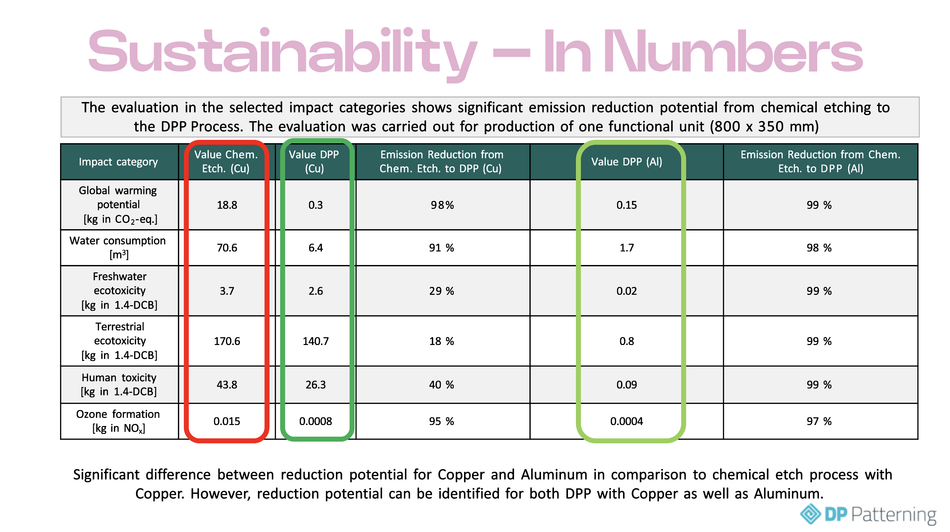
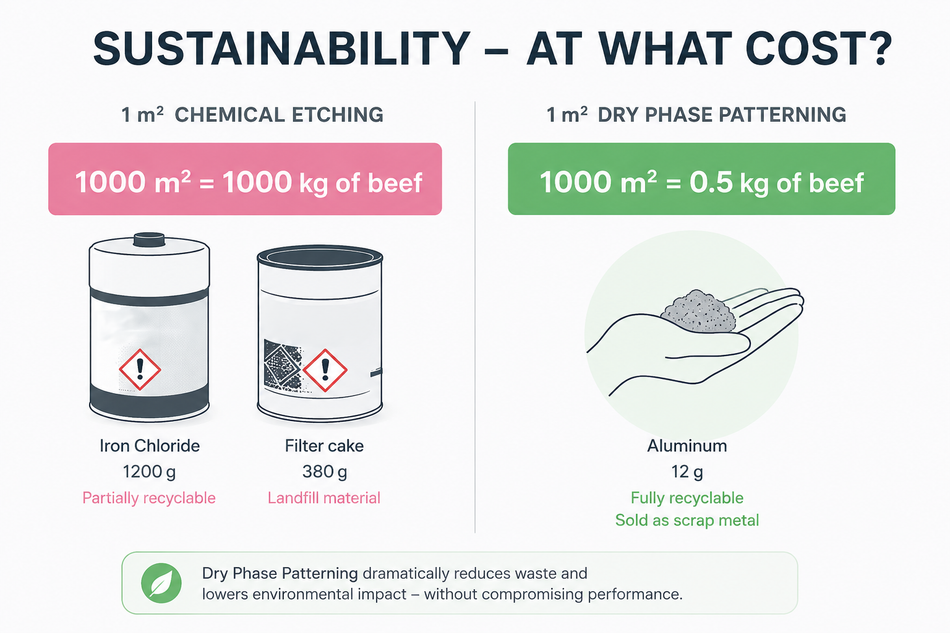
Whereas etching RFID and NFC antennas requires the use of corrosive chemicals and large quantities of water, Dry Phase Patterning is a mechanical process that does not use any chemicals or directly consume any water. Moreover, any metal cut away in the milling process can be collected and recycled in full. This resource efficiency translates to a highly economical process that can manufacture RFID and NFC antennas scalably (using a roll-to-roll system) and sustainably (with virtually no material waste and minimal energy input).
Dry Phase Patterning also has the potential to become even more sustainable through the use of paper substrates. Paper could replace more commonly used PET as a carrier material, reducing the reliance of RFID and NFC tags on non-renewable, petroleum-derived plastic, while still offering flexibility and functionality. Paper, as a highly renewable and fully recyclable material, is also more scalable than PET and has a far lower risk of resource depletion. Turning to paper for antennas can therefore not only improve sustainability metrics, but also support the future-proofing of RFID/NFC production workflows. Paper is also, notably, a more affordable resource than plastic, with Wang stating: “The future cost of paper antennas will still be lower than that of PET.”
The main question today surrounding paper-based RFID antennas is related to their performance. But studies are showing that antennas made using the Dry Phase Patterning process and a paper carrier are competitive with commercially printed RFIDs. In fact, a recent study from Sweden’s state-owned research institute RISE comparing a printed Ag PET RFID antenna to a Al paper-substrate antenna made using Dry Phase Patterning, found that the latter had a better reading distance (10.75 meters vs 10.67 meters) and comparable Received Signal Strength Indicator (RSSI).
Supporting an industry shift
While the aforementioned RISE study is highly promising, it is important to note that more development and—crucially—standarization must be done in order for sustainable paper-based RFID and NFC tags to become the norm.
“There are no dedicated testing standards for eco-friendly antennas; most companies refer to the testing guidelines for etched antennas, which is unscientific,” explains Eric Wang.
In other words, as with any emerging, transformative solutions, there is more work to do.
Ultimately, however, Dry Phase Patterning is playing an important role in the development of green RFID antennas and demonstrating that just because a process is sustainable it isn’t necessarily less economical than its resource-heavy counterpart. To the contrary. Dry Phase Patterning is a resource efficient process that can help the RFID manufacturing industry progress towards a more sustainable, more circular future, whether it's for product inventory labels, medical ID wristbands, or shipment tracking.
In an effort to accelerate the development and adoption of more sustainable RFID/NFC production, DP Patterning offers customers a pilot trial for new applications. Through this framework, DP Patterning works with customers to fine tune designs, test materials, and go through prototyping and production—with cost transparency along the way. For DP Patterning, the pilot trial fits into its broader ethos of innovating through collaboration.
Interested in being the next pilot project? Get in touch with DP Patterning to start innovating through collaboration.
References
[1] Radio Frequency Identification Technology Market (2025 - 2030) [Internet]. Grand View Research, 2025. https://www.grandviewresearch.com/industry-analysis/radio-frequency-identification-rfid-technology-market
[2] Bukova B, Tengler J, Brumercikova E, Brumercik F, Kissova O. Environmental burden case study of RFID technology in logistics centre. Sensors. 2023 Jan 22;23(3):1268. https://doi.org/10.3390/s23031268