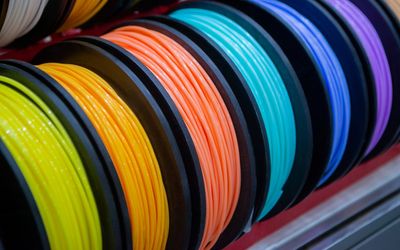
What is 3D printer filament made of? This guide examines polymers, additives, and composites, offering practical tips for digital design and hardware engineers.
Be the first to know.
Get our Materials weekly email digest.
Category
Materials
Engineers Wiki. Most Asked Questions.
How to Solder Wires: Comprehensive Guide for Engineers
By Umar Waseem.
15 minutes read.
ABS vs PLA: Which Filament Should You Use?
By Benedict O'Neill.
18 minutes read.
View more
ORGANIZATIONS. SHAPING THE INDUSTRY.


The Next Byte
Entertainment
The Next Byte Podcast is hosted by two young engineers - Daniel and Farbod - who select the most interesting tech/engineering cont...
165 Posts




ETH Zurich
University for science and technology
Freedom and individual responsibility, entrepreneurial spirit and open-min...
43 Posts
View more
TAGGED WITH smart material printing

Advancing New Horizons in Additive Manufacturing (AM)

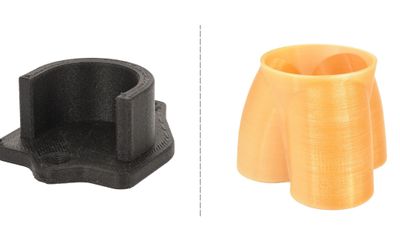
Discover how to print with high-performance filaments like PEEK, PEKK, and ULTEM. Learn about their properties, hardware needs, challenges, and best practices for industrial-grade 3D printing.

Explore how 3D-Fuel's Pro PCTG filament advances additive manufacturing, offering higher impact strength, improved environmental resistance, and reliable printability for functional and industrial 3D printing applications.


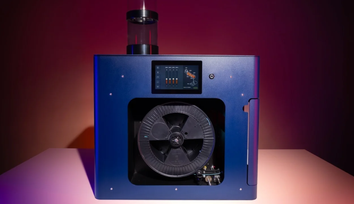
3devo's next-generation desktop extruder combines industrial precision with lab-scale simplicity enabling more controlled, higher-performance and data-driven 3D printing material workflows.
TAGGED WITH lightweighting

Lightweighting materials play a crucial role in offering the potential for improved fuel efficiency, enhanced performance, and reduced emissions in the automotive industry. It is anticipated that the lighter and more efficient automotive materials and components will revolutionize the industry in the coming years.

Latest Posts
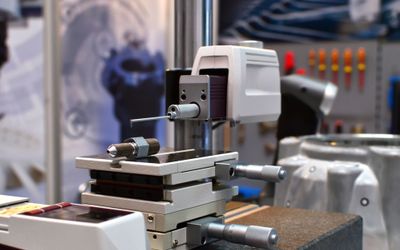
Measuring surface roughness allows metrologists to establish the roughness of a surface for quality control or other purposes. But how exactly is it done?


Ongoing research in thermoplastic materials science since its inception has led to groundbreaking discoveries like nylon and Kevlar, and now focuses on innovative formulations and processing methods, pushing technological boundaries, as explored in this chapter on the latest advancements.


Stanford researchers have developed a new phase-change memory that could help computers process large amounts of data faster and more efficiently.

4 minutes read


Ensuring the right level of hardness for your CNC machined part

4 minutes read


Silver/silver chloride (Ag/AgCl) is a conductive ink typically used to print electrodes for biomedical applications.

3 minutes read


An MIT team precisely controlled an ultrathin magnet at room temperature, which could enable faster, more efficient processors and computer memories.

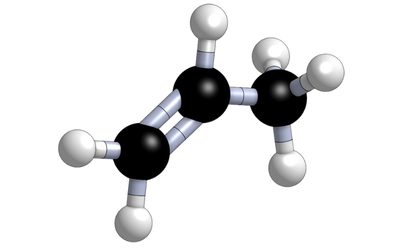
The glass transition temperature (Tg) is a fundamental property that allows us to predict, understand and manipulate the performance of polymer materials.



In the automotive industry, the focus is on seamlessly integrating advanced technologies such as touchscreens, digital dashboards and driver assistance systems into the interior without compromising driving comfort or aesthetics.

3 minutes read

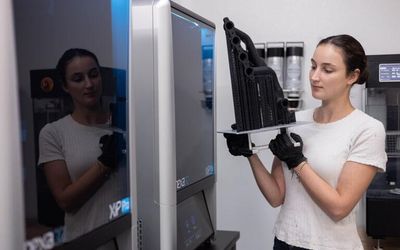
Nexa3D’s patented Lubricant Sublayer Photo-curing (LSPc) technology can print at up to 24 vertical centimeters per hour. That means more prototypes in less time.


Energy materials facilitate the conversion or transmission of energy. They also play an essential role in how we store energy, reduce power consumption, and develop cleaner, efficient energy solutions.

4 minutes read

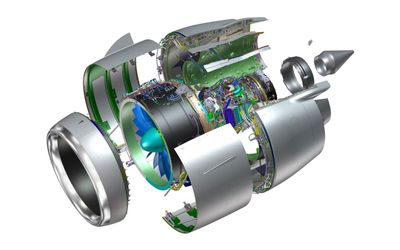
To enhance the applicability of thermoplastics across various industries, reinforcing additives are added to improve properties such as mechanical strength, UV resistance, and conductivity, contributing to the material's overall performance.


Ankur Gupta (MSE’10) is working to develop the battery technologies needed to bring augmented and mixed reality products to market at Meta.

3 minutes read


This chapter excerpt discusses thermoplastic processing in engineering, highlighting challenges like precise parameter control and moisture sensitivity while emphasizing methods like injection molding, extrusion, and additive manufacturing for shaping thermoplastics to meet diverse needs.


Use thermoplastic resin flow analysis to improve the mouldability of your parts.
3 minutes read


In the world of printed electronics, surface energy often comes up around the interactions of materials, specifically when we’re printing conductive inks onto various surfaces (substrates).
7 minutes read